Learning Vietnamese in Saigon: what actually helps.
The Vietnamese you hear in Ho Chi Minh City has words and sounds of its own. Here’s how to learn that version, a plan for your first months, and what to look for in an app.
Free to start on iPhone, iPad, Apple Watch and Android.
Learn the Saigon version first
Most of the language is shared across Vietnam, but Ho Chi Minh City has everyday words and sounds of its own. If you live here, learn the version you’ll hear every day, and pick up the Northern words as you meet them.
| English | Saigon | Hanoi |
|---|---|---|
| mom | má | mẹ |
| fruit | trái | quả |
| pig, pork | heo | lợn |
| a glass | ly | cốc |
| to go in | vô | vào |
| yes (polite) | dạ | vâng |
How it sounds
- Hỏi and ngã usually sound alike. Two of the six tones merge in everyday Southern speech.
- V, d and gi often sound like a y. Vui (happy) can sound close to “yui”.
- Final n and ng blur together. Bạn (friend) often sounds like “bạng”, and a final t can sound like c.
A plan for your first months in Saigon
- Get the sounds right early.
Six tones in the North, effectively five in Saigon. Practise hearing similar words apart (bàn, bán, bạn) before you build a big vocabulary on shaky sounds.
- Learn the pronouns that fit.
Anh, chị, em: Vietnamese picks a word for “you” and “I” by age and relationship. Getting them right matters more than perfect grammar.
- Start with the city’s everyday situations.
Greetings, numbers and prices, ordering food and drinks, directions for a driver. You’ll use them the same day.
- A few minutes every day.
Short daily flashcard sessions beat a long weekend cram. Your phone is with you on every ride and in every coffee queue.
- Use it out loud.
Order your cà phê sữa đá in Vietnamese. Go to a language exchange, where people are there to practise with you.
- Learn your own words.
The menu at your local place, the signs on your street, your teacher’s notes. They stick because you need them.
What to look for in an app for Saigon Vietnamese
Many courses teach Hanoi Vietnamese. It’s understood everywhere, but it isn’t what you’ll hear on the street in Saigon.
Audio, phrases and usage notes follow how Saigon speaks, and the Saigon words come first.
Vocabulary only becomes speech when you see how words fit together.
1,000 practice sentences with colour-coded grammar: tap a word and see what it does.
Without a plan, most people stall after the first hundred words.
3,000 core words in three levels and 50 lessons from beginner to advanced.
The words you need are rarely in a textbook’s order.
Snap a menu, a sign or your teacher’s notes and get a flashcard set of exactly that.
An app can’t talk back the way a person does.
Events lists today’s language exchanges, live music and meetups in Saigon, and the city guide has places to eat and go out.
Make practice feel like a game
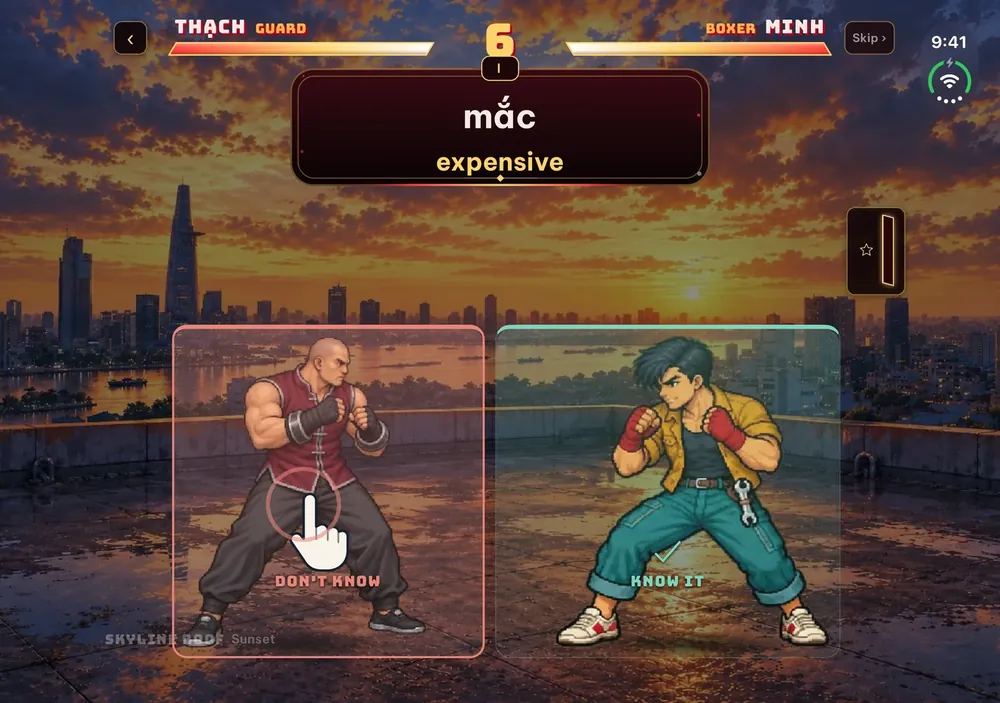
Saigon Battle turns review into an arcade fight: choose a fighter, answer with your vocabulary and sentences, earn stars and take on bosses across the city map. Flashcards also come with you on Apple Watch, and bundled cards, sentences and audio work offline after setup.
Honest limits
- An app is half of it. You still need to speak with people. Use the app to prepare, then go and use it.
- It teaches Southern Vietnamese. Northern speakers will understand you, but if you’re moving to Hanoi, a Northern course fits better.
- Events and the city guide are for Saigon. The words and sentences work anywhere; the listings are Ho Chi Minh City only.
- Free to start; full access is paid. You can start for free. Full access is a subscription, and new subscribers can try it free for 7 days.
Questions
Is Southern Vietnamese very different from Northern?
It’s the same language. Some everyday words differ (má and mẹ for mom, heo and lợn for pork), and some sounds change: two tones merge, and v, d and gi often sound like y. Speakers of each understand the other.
Should I learn Southern Vietnamese if I live in Ho Chi Minh City?
Yes. It’s what you’ll hear at the market, in cafés and from your neighbours, so it’s the fastest way to understand and be understood day to day.
What should a beginner learn first?
The sounds and tones, the pronouns (anh, chị, em), then greetings, numbers and prices, and ordering food. The app’s Beginner course starts with greetings, numbers and prices, and ordering food.
Is Learn Vietnamese: Saigon free?
It’s free to download and start. New subscribers can try full access free for 7 days; after that it’s a subscription you can cancel at any time.
Which devices does it run on?
iPhone, iPad, Apple Watch and Android. Bundled flashcards, sentences and audio work offline after setup.